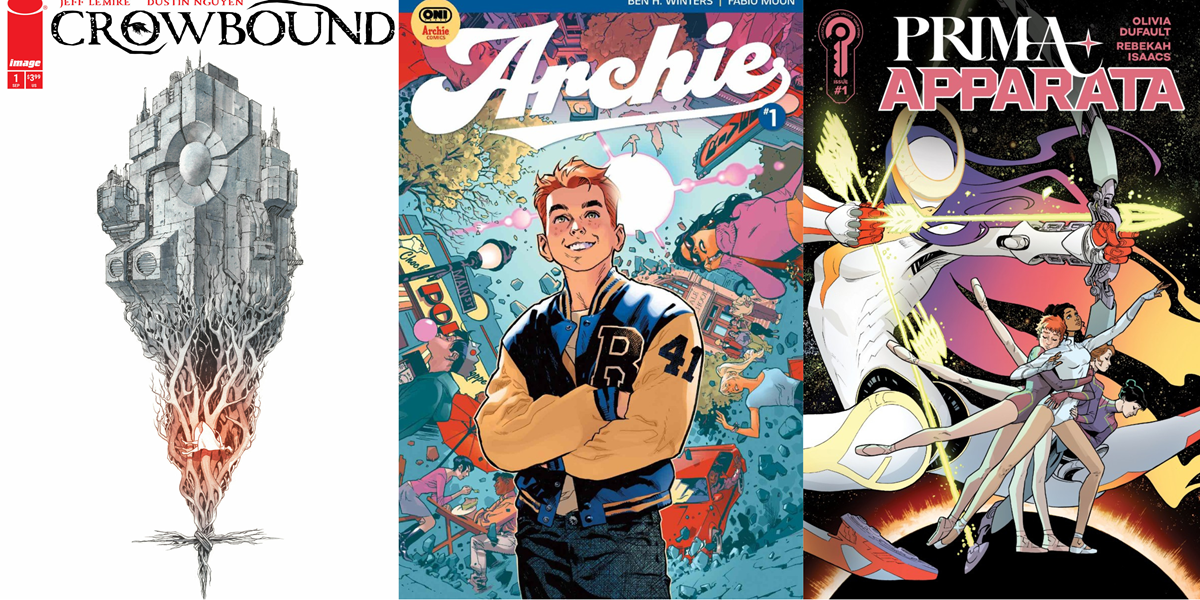

This week’s Wednesday Comics Reviews is looking at the latest Archie #1, the new Ignition Press series Prima Apparatta, and the lastest Jeff Lemire-Dustin Nguyen collab, Crowbound! Plus, The Prog Report!
 Archie #1
Writer: Ben H. Winters
Artist: Fábio Moon
Colorist: Jason Wordie
Letterer: Andworld Design Lettering Studio
Publisher: Oni-Lion Forge
Review by Jordan Jennings
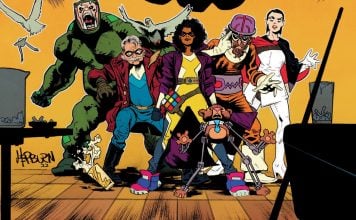
The Riverdale day gang has returned with this week’s Archie #1. This latest relaunch of one of comics’ longest running comedy books is a refreshing update that is perfectly crafted to be a delight. The decision by Ben H. Winter and Fábio Moon to focus on multiple features instead of a single issue-long story contributes to this series’ strong start. Through the use of three distinct features, the issue finds the right balance in humor, pacing, and even some bits of existentialism by the way of Jughead.
The first feature Rude Awakening serves masterfully as an introduction to the main Riverdale gang and Archie’s relationship with them all while Archie tries to get it school in time. It feels reminiscent of the extended Simpsons intro with the family rushing through Springfield and seeing most of the characters along the way. Winter’s writing is efficient in its humor and speed throughout the book, really. This is more evident during the second feature “Yes, We Cannes” is about the gang making widely varied short films for the town film festival. Of course, Archie is wanted as the leading man for all these ideas and can’t bring himself to say no despite wanting to make his own film. The cuts are brisk and humorous as well as showing more of the Riverdale cast.
Winter captures the characters’ voices quite well but especially Jughead as evident by the ponderous and existential “Jughead’s Journal” feature that promises to be an ongoing feature for the series. Winter is able to balance the deceptively simple humor with these comparatively hefty moments to the point I swore multiple writers were working on this book ala an anthology but nope. The ability to just change it up mid-issue is impressive.
I would be remiss if I didn’t take a moment to discuss Fábio Moon’s deft draftsmanship with the illustrations. The pages throughout follow somewhat conventional comic layouts, but he peppers these novel transit scenes showing Archie moving through the neighborhood. It’s a fun visual tool for these scene transitions that enable gags. The gags in the comic are a delight, be it Archie’s closet or the same outfit or the baby yelling double wah as Archie zoomed by them a second time during the same afternoon. Jason Wordie’s vibrant colors really complements the much more light-hearted tone of the story.
Moon is able to imbue so much character and personality into an updated Archie house- style. The revamped character models are fantastic across the board. My favorite is Jughead. He is still rocking his signature hat, but now donning a nice yellow flannel jacket. It’s a simple update to the character but a great one nonetheless. The body styles are more varied that traditional as evident by Betty and Veronica. They are still very much the classic blonde and brunette fans come to expect but they don’t resemble just palette swaps. Veronica is a bit more lanky and Betty is more of a wider frame. It is a subtle shift but a welcomed one.
Archie #1 is a great relaunch to one of comics’ longest running mainstays. A must-read for anyone looking for some joy in their life.
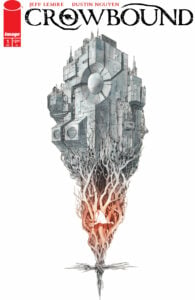 Crowbound #1
Writers: Jeff Lemire
Artist: Dustin Nguyen
Letterer: Steve Wands
Publisher: Image Comics
Review by Jared Bird
Rosie can feel herself dying. Falling down, throat slit, succumbing to the emptiness. Yet, she can’t let herself fade just yet. Her daughter, Ava, is still out there, in danger, and she isn’t about to let her die. In this brand new dystopian fantasy series from the award-winning team behind Little Monsters and Descender, a mother ventures to save her daughter and fight against the corrupt, merciless system they live in.
Set in a secondary fantasy world, both dystopian and medieval in equal measure, which sees adults of all ages working aimlessly for The Factory, in pursuit of some sort of ‘protection’ from the ominous, chthonic force that threatens their life. They tirelessly aid in the construction of The Wall, which keeps The Eater at bay… for now. Rosie is one such worker, with her young daughter Ava just shy of turning twelve years old. When Ava is kidnapped, Rosie risks her own life, and the balance of the lives around her, in order to rescue her. As the first issue balances between past, present and future, it builds up a striking and interesting premise that, whilst it feels predictable on paper, has a fascinating and exciting execution that leaves the reader desperate for more.
Jeff Lemire is legendary in the comics space, and his writing is confident and effective here. He easily places you in the mindset of a concerned parent, effortlessly getting you to invest in Rosie and her perspective. Her dynamic with Ava, whilst not explored in a huge amount of detail yet, has a wonderfully solid groundwork, and you connect to it as much as you need to for the premise to work. The worldbuilding is minimal yet incredibly effective, constructing a wonderful atmosphere in addition to an interesting world full of threats for our protagonists to take down. Lemire’s best moments here, however, are when he allows himself to dip into a more poetic narrative style, harnessing the painterly element of Nguyen’s artwork to the best of his ability to craft something wonderful and striking.
Dustin Nguyen’s brilliant artwork takes the atmosphere to another level, with his lush and gorgeous watercolour style providing a gothic and dark atmosphere that really heightens the material. Reminiscent of the atmospheric work of Japanese artist Yoshitoshi Abe, Nguyen crafts a world that’s dark yet magical in equal measure, where you feel such a powerful urge to explore further, yet a degree of fear and apprehension at the darkness that may lie beneath. Additionally, his style reads really well, helping pace out the story and emphasising each narrative beat as required. The two work together brilliantly as a team, and it’s exciting to see their newest collaboration feels distinct from their previous ones, never relying on the hits.
Crowbound #1 begins the latest collaboration between Dustin Nguyen and Jeff Lemire on a strong note, with a lush gothic atmosphere that compliments the striking, dark worldbuilding, whilst never sacrificing the emotionally intimate story that serves as the very core of the story. Brilliantly told with poetic, compelling language, and stunning art, it’s going to be a delight for long-term fans of the creative team, but is fresh and exciting for newcomers at the same time. Fantasy comics are in a great place right now, with new and interesting stories coming out of the woodwork, and this has been one of the strongest of the year so far, definitely a worthwhile read for genre enthusiasts and those who love intimate stories told through beautiful art and writing.
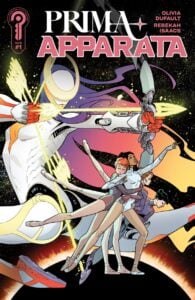 Prima Apparata #1
Writer: Olivia Dufault
Artist: Rebekah Isaacs
Colorist: Marissa Louise
Letterer: Becca Carey
Publisher: Ignition Press
Review by Samantha Puc
“We all know the story of Appolyta the Huntress,” but if the augmented, cloned students at the Conservatory cannot perform the story to the satisfaction of its alien Patrons, they’ll be killed on the spot—accolades be damned.
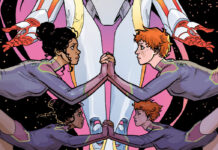
Prima Apparata #1 introduces a future-flung world in which humanity’s most talented young women train at a celestial boarding school to be the next generation of mech pilots, driving their suits through fine-tuned ballet. The goal isn’t war, it’s performance: Each girl hopes to become Prima Apparata, the top of her class, to perform for the Patrons at the annual recital.
This year’s top students, Mar and Rhea, couldn’t be more different—but their bond is instant and deep, and as they compete for the top spot, the lines begin to blur.
The premier issue of this Ignition Press series kicks off with a bang, immediately establishing the stakes through an audition in which girls who don’t perform well enough are jettisoned into space and left to float dead in the surrounding atmosphere. Their instructor, Madame V, reiterates these stakes to one of the two protagonists, Mar, before she is sent off to be “amended” through a series of augmentation surgeries.
In her recovery room, Mar is visited by Rhea, who’s figured out how to unplug herself from the various machines keeping her pain at bay. Rhea wants to escape the Conservatory. Mar wants to stay: “They’re making us better, right? I’d like to be better.”
Writer Olivia Dufault narrates the story of Appolyta the Huntress through Mar’s POV, interjecting dialogue to establish the characters’ personalities and goals. This creates the structure for the world of Prima Apparata, which artist Rebekah Isaacs and colorist Marissa Louise then populate with extravagantly detailed character designs, architectural wonders, and dreamy mech suits. Becca Carey’s lettering is the secret ingredient bringing it all together, revealing a creative team at the top of its game.
The story is brilliant from the jump, the hook too good to ignore. The PR material for Prima Apparata describes it as a combination of Never Let Me Go, Pacific Rim, and Black Swan, and there are hints of all three here, but also elements of Bitch Planet that feel particularly exciting. Most intriguing is the relationship between Mar and Rhea, which is already marked for doom not just because they have to compete to perform, but because Mar has accepted—nay, embraced—her augmentations and purpose at the Conservatory, whereas Rhea has not. This likely spells danger for the latter, whose enrollment at the school and desperation to escape it raises questions. Was she forcibly enrolled? Is she at the Conservatory to tear it down?
Whatever is to come, this reviewer is completely onboard. Prima Apparata #1 is propulsive, elegant, and uniquely horrifying, deserving of a spot on everyone’s pull list.
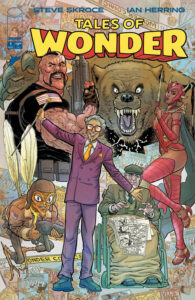 Tales of Wonder #1
Writer and Artist: Steve Skroce
Colors: Ian Herring
Letters: Pat Brosseau
Publisher: Image Comics/Skybound Entertainment
Review by Clyde Hall
Stu Reeds is seeing moviegoers thrill to the cinematic adaptation of the superhero foursome he created decades ago. At age 95, it’s the pop culture acknowledgement he’s sought and worked for across his writing career, and he’s drunk on the heady nectar of success. Jake Crumsby was the artist who gave Stu’s vision its distinctive graphic adventure form in those bygone 1960s comic titles under work-for-hire arrangements. The Wonder Comics Group grew from the little- company-who-could to a major entertainment corporation based on Stu’s showmanship and flair for scripting, and on the work of artists and writers like Jake who toiled for the company by earning a flat fee.
Together, they became a marriage of creative talents that changed the American comic art form. One to the tune of a considerable personal fortune, the other to vast critical acclaim but much less financial gain.
Their historic collaboration is now the stuff of legend, but the honeymoon was over between them by the 1970s. The years since have been an ongoing, bitter feud over the lopsided profit scale and the question of who deserves the most credit for the superhero magic they bestowed to generations of fans.
Now, both nonagenarian creators are Guests of Honor at a Special Non-SDCC Con screening of the blockbuster film based on their America’s Freedom Force team. It’s a chance for Stu and Jake to bury the hatchet and bask in the glow of adoration and achievement. Or to take to the stage for one final public donnybrook over who did what and who is the true ‘father’ of the AFF. Neither expected the arrival of that superhero team…not cosplayers, the actual characters leaping from the printed pages and into real life…to muddy the attribution waters further. But leap the Fantastic Foursome did, and they’ve brought along some of their worst villains for the ride.
You can tell by the first issue of Tales of Wonder that writer and artist Steve Skroce had fun playing with the tropes here, riffing on the House of Ideas catchphrases and larger-than-life personalities. Things like ‘Wonderites’ and ‘Upwards and onwards!’ trip from the tongue almost as readily as the carnival barker banter that so excited and inspired young Merry Marvel Marching Society members back in the day.
And it’s easy getting caught up in his What-Ifs regarding 90-something Stan Lee and Jack Kirby on stage together after a screening of Marvel Studios films featuring their creations. Would it have been a chance to share the limelight and let bygones go, or become one final exchange of accusations and maybe even a bit of toupee-pulling for good measure?
The satirical edge is sharp and unforgiving, honed on the whetstone of debate that has defined certain corners of fandom for generations. At times, you can imagine Ryan Reynolds narration with something like, “I know what you’re wondering. How are we gonna do this without dishonoring Stan’s and Jack’s…I mean Stu’s and Jake’s…memory? Well, we’re not.”
Based on how biting the sarcasm runs in this premiere of the 5-part miniseries, it may even turn out to have the same heartfelt closure Deadpool & Wolverine did. I really hope so. Because the Stu and Jake bickerfest was clever. But it also cut open old hurts.
That probably sounds melodramatic, but as an older comics fan, I’ve seen the airing of such debate, arguing, and dirty creative laundry for half a century. And while bringing back cinematic Wolverine after the excellent ‘final chapter’ of Logan worked in that knife’s edge way of calling out the Fox Studios flaws humorously while paying tribute to the joy their films brought, it was novel. Only done once, at least so far.
Zinging analogs of Stan, the Marvel bullpen, and Jack Kirby, though, have been done more than a few times. And in some instances, by the men involved themselves via venues like Fourth World vent fic. Not without worthwhile results, perhaps. Companies have in some cases made amends to families of writers and artists long denied credit or compensation for their contributions. The fight goes on.
Subjectively, the setup portion of the book felt like reopening old wounds yet again, and for me that diminished the fun. And also the funny. I remember hitting my teens and seeing Stan as a huckster instead of the Soapbox hero I once imagined as a wee reader. And I remember still being happy that Stan lived to see his work and vision appreciated on a global scale the way comics fans had appreciated it years before. I wish more of those who crafted it in combination with him had lived so long. And been fairly compensated for what they brought to the party.
There are nice touches along the way which raise my hopes for the subsequent issues, though. The breakdown of the comic book faithful across genres, genders, and generations by Don Kingsley, Wonder Studios producer and director, is deliciously dark villainy in the making. Initial interactions between the AFF characters come to life and their creators is equally promising. “Why’d you always draw me like this, Jake?!” and, “How come I never got the girl, Stu?!” or similar creation-to-creator commentaries are likely coming.
Skroce’s art, and the vibrancy Ian Herring’s colors bestow on it, are an effective, efficient combination for telling such a story. The exaggerated wrinklescapes and posturing of our elderly protagonists help with the humorous tone the storyline’s shooting for. The AFF characters are bizarre and interesting in a modern way, much like the FF were in their era. Their introduction is brief, but the style applied by Herring and Skroce make them characters we want to learn more about.
The Tales of Wonder title’s appeal will be balanced by how much you want to see analogs of those in the Lee-Kirby dispute plead their cases once more. And in how much humor you can draw from that sort of resurrection. Those portions of the first issue didn’t hook me, but other parts did. Enough so, I trust following issues in the miniseries will make any initial cringe factor smooth over and work toward a fulfilling final chapter. And a degree of heartfelt closure regarding two creative giants who entertained us ceaselessly despite their frictions and human failings. And who still do.
The Prog Report
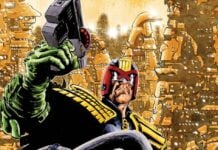
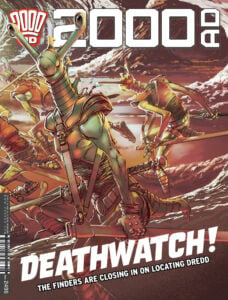 2000AD #2496 (Rebellion): I’ve been hoping for a while that the ongoing Dredd storyline — The Oubliette — would start to speed toward its ending, and this week we definitely get that, spread across two strips in this week’s magazine. It gave me occassion to take stock of this storyline as a whole, and you know what? I think it’s been a good time. Will it be a Dredd classic? I’m not sure about that, but it’s been a fun and mysterious adventure to follow week-to-week through several different storytellers. This week’s cover (above) is by Jake Lynch. As always, you can pick up a digital copy of The Prog here. And it is also now available weekly in US comic shops! —Zack Quaintance
Column edited by Zack Quaintance
Read past entries in the weekly Wednesday Comics reviews series or check-out our other reviews here!